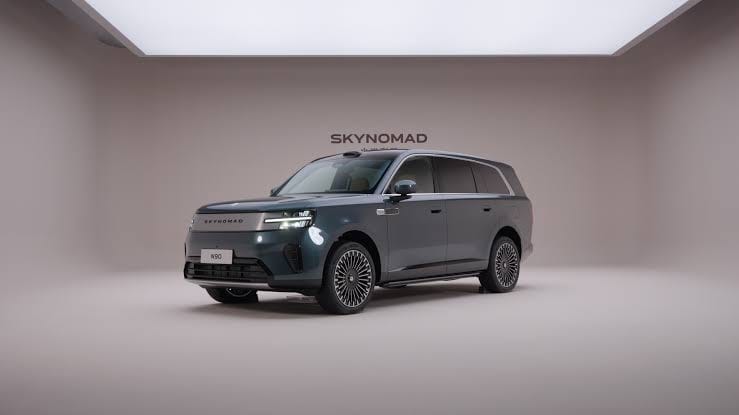
Xiaomi did not enter the car business to play it safe. Built around the ideas of "Innovation for Everyone" and "Human x Car x Home," the brand has already unsettled the segment with the SU7 and YU7, cars that match established rivals feature for feature while undercutting them on price. Now Xiaomi is aiming higher with an entirely new family of vehicles: the SkyNomad.
There are two launch models. The SkyNomad N70 is a five seat midsize luxury SUV, and the SkyNomad N90 is a seven seat flagship with a 2-2-3 layout built for chauffeured executives and road tripping families alike. Neither has been confirmed for the Emirates yet, but given how quickly Chinese brands have moved into this market, they are worth understanding now. Here is everything that stands out.
The Flagship Arrives: Meet the SkyNomad N90 Max
At just over 5.29 m long, the N90 Max is the model wearing the crown. Its 2-2-3 seating arrangement gives second row passengers proper captain's chairs while still leaving room for three across the back, a layout that works as well for a boardroom on wheels experience as it does for a big family heading to the beach.
The real story is underneath. Xiaomi's new Kunlun platform delivers a completely flat floor over the battery pack and slimmer wheel wells, freeing up cabin space most SUVs simply cannot match. It also enables something genuinely rare: seats, front and rear, that rotate a full 360 degrees, a party trick normally reserved for minivans and buses. Xiaomi is pitching the cabin as one of the safest in the industry, going well beyond typical safety benchmarks. If big three row SUVs are your priority, our guide to the best SUVs in the UAE covers what is actually available here today.
Power Without the Range Anxiety
Every SkyNomad N90 trim ships with a 1.5 litre petrol range extender, but here is the twist: the engine never touches the wheels. It exists purely to top up the battery, meaning every kilometre is driven on electric power alone. Xiaomi claims a combined range approaching 1,705 km on the CLTC cycle when the range extender and battery work together.
Buyers get a choice of two batteries. A 52kWh LFP pack is good for around 300 km on electricity alone, while a larger 76kWh NMC unit stretches pure electric range to around 505 km. These are optimistic CLTC figures, and UAE summer heat with the air conditioning at full tilt would pull them down noticeably, but even scaled back they represent serious numbers for a vehicle this size. It is no slouch either: the range topping version covers 0 to 100 km/h in just 5.9 seconds.
Under the Skin: How the Powertrain Actually Works
This is the part that trips people up, so it is worth breaking down properly. The SkyNomad range does not use its 1.5 litre petrol engine to drive the wheels at all. Think of it purely as an onboard generator, usually called a range extender or an EREV, short for Extended Range Electric Vehicle. Every bit of motion comes from the electric motors, and the petrol engine's only job is to keep the battery topped up once it starts running low.
That single design choice solves two problems at once. First, it gives the SkyNomad the smooth, silent, instant torque feel of a pure EV at all times, because there is no engine physically connected to the drivetrain to disrupt it. Second, it removes the range anxiety that still holds some buyers back from going fully electric, since a nearly empty battery just means the generator kicks in rather than a long charging stop. That matters more in the UAE than in China, where a Dubai to Riyadh run still crosses long stretches with thin fast charging coverage. For a look at what is on sale here right now, browse our electric cars in the UAE listings.
The numbers at a glance:
- Range extender: 1.5 litre petrol engine, generator only, with no mechanical drive to the wheels.
- Fuel tank: around 60 litres, enabling a combined range of up to roughly 1,705 km on the CLTC cycle.
- Battery option 1: 52kWh LFP, up to around 300 km on electric power alone.
- Battery option 2: 76kWh NMC, up to around 505 km on electric power alone.
- 0 to 100 km/h: 5.9 seconds on the range topping variant.
The upshot is that buyers get to choose their priority. Go for the smaller battery for a lighter, more affordable entry point, or step up to the 76kWh pack for a genuinely usable daily electric range with the petrol generator only stepping in on longer hauls. Either way, performance stays firmly in quick SUV territory.
Exterior Design: Bold, But Make It Elegant

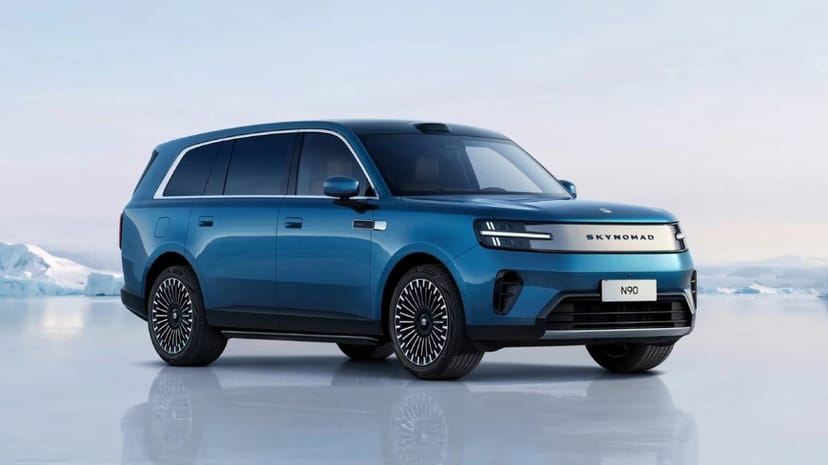
The N90 Max does not try to blend in. It is a big, monolithic presence on the road, and it knows it. Dragonfly style headlights bring a touch of finesse to an otherwise imposing front end, flowing into a wide panel that spells out the SkyNomad name across the nose.
Yes, there is a LiDAR sensor poking out of the windscreen, a now familiar sight on tech forward EVs, but it earns its keep by unlocking a suite of advanced driver assist features.
The squared off body signals maximum interior space, while frameless wing mirrors soften the blocky silhouette and add a genuine sense of occasion. Step up to any door and an automatic side step deploys to help you climb aboard, a small detail that makes a big difference on a vehicle this tall. Add chunky 21 inch multi spoke alloys in black and aluminium, plus a rear end signature built around a sweeping LED light bar that nods to the SU7 and YU7 without copying them, and you have a design that means business.
Step Inside: Where Xiaomi Really Shows Off
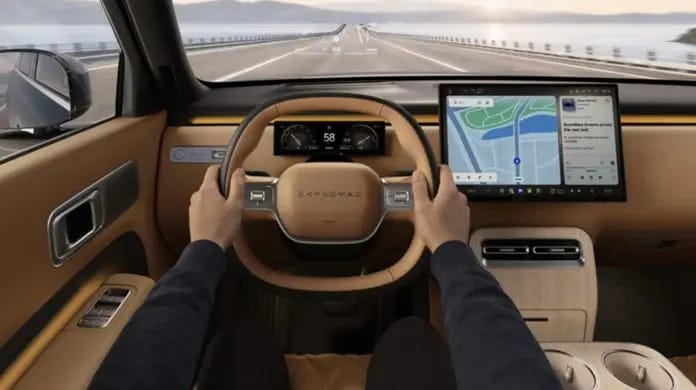
If the exterior says presence, the interior says please sit down and stay a while. Xiaomi has clearly poured its engineering budget into the cabin, wrapping roughly 95 percent of touchpoints in soft padding and prioritising comfort at every turn.
This is not really an SUV cabin in the traditional sense. It is designed as a living room that happens to move. The steering wheel is flattened for easier entry and exit, a small trade off for manoeuvrability, while a clean, no nonsense gauge cluster sits behind it, backed by a genuinely useful head up display that means you rarely need to glance down at all.
Dominating the dash is a 16.1 inch, 3K resolution centre display that controls almost everything in the car, including those show stopping rotating seats. Underneath it, a bank of drawers looks more like bedroom furniture than a glovebox, offering discreet storage that feels genuinely premium. The centre console itself slides forward and back at the press of a button, freeing up space exactly where you need it, with cupholders, wireless charging and hidden storage built in. Overhead, a dual pane sunroof opens at the front and glows softly at the rear to set the mood.
Even the door sills, conventional at first glance, hide a luxury flourish. Press the release and the door swings itself shut or open automatically, a feature usually reserved for the very top end of the market. It is the kind of detail you would normally only find on the cars in our luxury cars listings.
The Seats: The Real Headline Act
The seats are, without question, the star of this cabin. Front and second row chairs behave more like reclining sofas than car seats, swivelling to face forward or backward, sliding into countless positions and folding flat into a first class style lounge bed. Heating, cooling and massage functions come as standard, and the rotating function only activates once the car is parked, turning the SkyNomad into a mobile lounge rather than a traditional vehicle when stationary.
Rear passengers get their own dedicated fridge, a genuinely useful 9 litre compartment that opens from the base of the centre console and keeps working even with the car switched off, for the modest cost of about 1kWh a day. In a market where a cold drink after a walk across a summer car park is not a luxury, that one is likely to land well in the Gulf. There is also a personal control panel for rear seat passengers and a remote for the drop down 21.4 inch, 3K display that folds out of the roof lining, which suits movies, games or working on the move.
Even the third row impresses. A 1.95 m tall tester found comfortable space on every seat in the car, with maximum rear legroom stretching to an impressive 1.55 m. Floor mounted rails let every seat slide and reconfigure, so the cabin adapts to however you actually want to use it.
Practicality: Big Body, Bigger Brains
At nearly 5.29 m long, the N90 does not struggle for storage. With all three rows in place it swallows roughly seven carry on suitcases, or about 580 litres of cargo. Fold and shuffle the second and third rows and that number climbs to a cavernous 1,800 litres, plenty for a proper family move or a serious shopping trip. There is even a hidden underfloor compartment for smaller items you do not need front and centre.
Meet the Smaller Sibling: SkyNomad N70 Max
The N70 shares almost everything with its bigger brother, including the same drivetrain, the same battery options and the same design language up front, but trims the length down to just under 4.88 m. That shorter footprint should translate into sharper handling and tighter cornering, at the cost of a little outright space, and it would be the easier of the two to live with in a multi storey car park in Dubai Marina.
The proportions give the N70 a sportier, more muscular stance compared with the N90's stately presence, helped along by a noticeably shorter rear overhang that should also pay off in off road capability. From the back the two are near twins. Spot the badge, and that is about it.
That is by design. Xiaomi is not positioning the N70 as the budget SkyNomad. It is the same experience and the same status, just shaped for a different kind of buyer.
SkyNomad N90 vs N70: Which One Is Right for You?
Since the two models share so much, the real decision comes down to size, seating and how you actually plan to use the car. Here is how they stack up side by side.
| Factor | SkyNomad N90 Max | SkyNomad N70 Max |
|---|---|---|
| Body style | Seven seat flagship SUV | Five seat luxury SUV |
| Seating layout | 2-2-3, captain's chairs plus a rear bench | Traditional five seat layout |
| Length | About 5.29 m | Just under 4.88 m |
| Driving character | Stately and chauffeur friendly | Sportier and more agile in corners |
| Rear overhang | Longer | Shorter, so a better departure angle off road |
| Powertrain | 1.5 litre range extender plus electric motors | Identical setup to the N90 |
| Battery options | 52kWh LFP or 76kWh NMC | The same 52kWh LFP or 76kWh NMC |
| Best suited for | Large families, executive transport, long road trips | Buyers who want SkyNomad status with tighter handling |
The takeaway is that this is not a case of flagship versus budget option. Xiaomi has deliberately built two cars that deliver the same technology, the same luxury feel and the same brand statement, just packaged into different footprints. Choose the N90 if you need the extra row and the ultimate lounge on wheels experience, or the N70 if you would rather have a tighter, sportier SUV without giving up any of the SkyNomad appeal.
What the SkyNomad Would Mean for UAE Buyers
The big open question for markets like the UAE is availability. Xiaomi has confirmed a future factory in Spain for 2027, though that plant is currently earmarked for SU7 and YU7 production rather than the SkyNomad range, and no UAE launch has been announced. For now the N90 and N70 remain a glimpse of what is possible.
That gap matters, because cars sometimes reach the Emirates ahead of an official launch through independent importers. If a SkyNomad appears in a UAE showroom before Xiaomi appoints a local distributor, it will almost certainly be a China specification grey import, with no manufacturer warranty, no local parts pipeline and no guarantee that its climate control and battery calibration were validated for Gulf heat. Our guide to buying Chinese cars in the UAE through an official dealer versus a grey import explains exactly what you would be giving up, and our explainer on GCC specs versus other specs covers why regional specification is not a technicality in this climate.
In the meantime, the Chinese brands already established here offer plenty of the same thinking at prices you can actually act on. Start with our roundup of the best Chinese cars in the UAE and the top five Chinese cars to buy in Dubai, compare the electric options in our best electric cars guide, then browse live stock across new cars, used cars and SUVs for sale in the UAE. If you are weighing up the monthly cost, our car loan calculator gives you the real figure before you commit, and any used import is worth a free VIN check first.
Frequently Asked Questions
Is the Xiaomi SkyNomad available in the UAE?
Not yet. The SkyNomad N90 and N70 have launched in China, and Xiaomi has confirmed a European factory in Spain for 2027 that is currently earmarked for SU7 and YU7 production rather than the SkyNomad range. There is no announced UAE launch date or official Xiaomi car distributor in the Emirates at the time of writing.
Is the Xiaomi SkyNomad a fully electric car?
It drives like one. Every SkyNomad is powered exclusively by electric motors, but it carries a 1.5 litre petrol engine that works purely as a generator to recharge the battery. The petrol engine is never mechanically connected to the wheels, which makes the SkyNomad an extended range electric vehicle, or EREV, rather than a conventional hybrid or a pure EV.
How far can the Xiaomi SkyNomad N90 travel?
Xiaomi quotes a combined range of roughly 1,705 km on the CLTC cycle with the battery and range extender working together. On electricity alone the 52kWh LFP battery is rated at around 300 km and the larger 76kWh NMC pack at around 505 km. CLTC is an optimistic Chinese test cycle, so expect meaningfully lower figures in real UAE driving with the air conditioning working hard.
What is the difference between the SkyNomad N90 and the N70?
Size and seating, mostly. The N90 Max is a seven seat flagship measuring about 5.29 m with a 2-2-3 layout and captain's chairs in the middle row. The N70 Max is a five seat SUV just under 4.88 m long with a shorter rear overhang. Both use the same range extender powertrain, the same two battery options and the same interior technology, so the N70 is not a budget version.
Do the Xiaomi SkyNomad seats really rotate 360 degrees?
Yes, on the front and second row seats, and only when the car is parked. The rotation is enabled by the flat floor of Xiaomi's Kunlun platform and is controlled from the 16.1 inch centre display, turning a stationary SkyNomad into a lounge rather than a conventional cabin.
How fast is the Xiaomi SkyNomad N90 Max?
The range topping N90 Max covers 0 to 100 km/h in 5.9 seconds, which is quick for a seven seat SUV of this size and puts it firmly in performance SUV territory rather than merely efficient SUV territory.
How much luggage space does the SkyNomad N90 have?
With all three rows upright the N90 holds about 580 litres, or roughly seven carry on suitcases. Folding and sliding the second and third rows opens that up to about 1,800 litres, and there is a hidden underfloor compartment for smaller items.
The Verdict: Xiaomi Is Not Just Building Cars Anymore
The SkyNomad N90 and N70 make one thing clear. Xiaomi is not interested in simply competing in the luxury SUV space, it wants to redefine what that space even means. Deep connectivity with the world outside the car, seats that turn a stationary vehicle into a private lounge, and genuinely clever use of space all point toward a brand thinking several steps ahead of the segment it has just entered.
Whether the SkyNomad reaches showrooms outside China, and when, is the story CarsClub will be watching closely. Until it does, the best way to judge how far Chinese brands have come is to sit in the ones already here: browse new cars, compare electric models, or narrow the search to your emirate with cars in Dubai.
First hand impressions and images referenced in this article originate from ArenaEV's early hands on coverage of the Xiaomi SkyNomad N90 and N70.