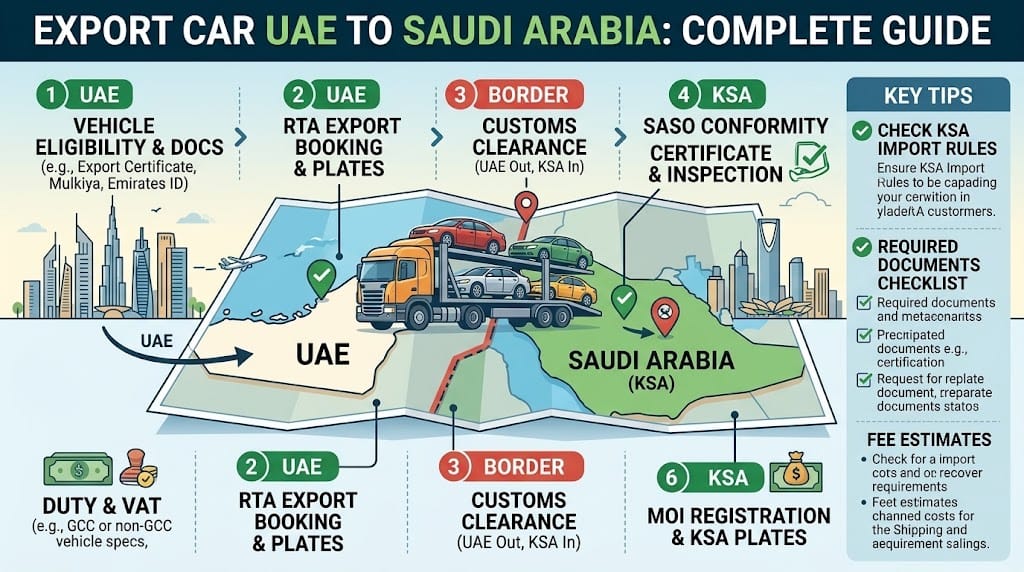
To export a car from UAE to Saudi Arabia you need an RTA export certificate costing AED 70, or AED 140 with export plates, and it is valid for just seven days. Before you pay for any of it, check one thing: Saudi Arabia will not admit a passenger car whose model year exceeds five years. Get that wrong and everything downstream is wasted.
Start with the Saudi rules, not the UAE ones
Most people do this in the wrong order, pay for UAE paperwork, then discover the car is ineligible. The binding rules come from the Saudi Zakat, Tax and Customs Authority.
ZATCA states that small vehicles, buses and light transport vehicles of 3.5 tonnes and under may be imported "provided that their model does not exceed 5 years, and their calculation is in descending order, except for the current year." Vehicles more than 30 years old may be imported as antiques. Heavy transport vehicles are limited to an operational life of five years, counted from 1 January of the year of manufacture.
ZATCA also publishes a prohibited list, and it is broader than people expect. Not importable: vehicles that have been sunk or subjected to an accident, fire or structural damage; vehicles previously used as taxis or police cars; vehicles carrying school transport logos; stolen vehicles; and vehicles whose chassis number has been tampered with.
Who may import is also capped. GCC citizens are allowed two vehicles annually; residents may import one private car every three years and are barred from transport vehicles. So no, you do not need a Saudi trading company to move one car, but you do need to fit the quota.
The right-hand-drive rule almost every guide gets wrong
Search this topic and you will repeatedly read that Saudi Arabia bans right-hand-drive cars. Shipping-company blogs state it flatly.
What ZATCA actually publishes is narrower: it is prohibited to import vehicles "if the steering wheel is modified from right to left." That is a ban on conversions, not on right-hand-drive vehicles as such. The distinction matters, because the sweeping version of the claim may be causing people to abandon perfectly legitimate exports.
Since we could not find the blanket ban stated on any Saudi government domain, treat the position as: converted steering is definitively prohibited, and confirm a factory right-hand-drive car's status with ZATCA directly rather than relying on a shipper's blog. The same caution applies to the SASO/SABER Certificate of Conformity that trade sites describe as mandatory: widely repeated, not confirmable on a Saudi government page.
What the RTA actually charges, and the 14-day trap
In Dubai, exporting is handled through the RTA's vehicle registration cancellation service. The published fees for a light vehicle are:
| Transaction | Components | Total |
|---|---|---|
| Export certificate only | Certificate AED 50 + Knowledge and Innovation fee AED 20 | AED 70 |
| Export certificate with export plates | Certificate AED 50 + export plates AED 70 + Knowledge and Innovation fee AED 20 | AED 140 |
An individual needs an Emirates ID, plus an electronic technical inspection if the registration card has expired. A company needs the authorised person's Emirates ID, the trade licence, a company letter, the sale and purchase agreement, and a memorandum of association translated into Arabic. You or a legal representative must attend in person at a Customer Happiness or inspection centre.
Then the two conditions that cost people money. First, the export certificate is valid for seven days. Do not start the process until the buyer, the transport and the crossing date are all lined up. Second, the plates must be handed over within 14 days of submitting and paying for the electronic application. Miss that and the transaction is cancelled with no refund. If the plates are lost, you will need a police report.
One further restriction worth taking seriously: once the vehicle is on export status, the RTA states you cannot drive it on internal roads, and driving is "only allowed on main roads leading out of the country." A car on export plates is not a car you run errands in.
Abu Dhabi's equivalent process runs through TAMM rather than the RTA, and we could not verify its fees or document list from a published page, so confirm those directly if the car is Abu Dhabi registered.
Clearing finance and fines first
Two blockers must be cleared before the registration can be cancelled at all.
All traffic fines must be paid. This is a stated RTA condition, not a formality, and unpaid fines will stop the transaction at the counter.
A financed vehicle must have its mortgage released electronically. The RTA's wording points to a system-to-system lift by the bank rather than a paper letter you carry in. Start that conversation with your bank well before you book anything. It is the step most likely to add a week you did not plan for.
Crossing at Al Ghuwaifat, and the taxes on the other side
The road route runs through Al Ghuwaifat on the UAE side and Al Batha on the Saudi side. Expect UAE customs and immigration formalities, then Saudi immigration and a customs inspection of the vehicle, then vehicle insurance purchased at booths before final entry. Saudi insurance must be in place before registration completes on the other side.
On tax, one figure is official and one is not. Saudi VAT is 15%, and ZATCA's own guidance is clear that the value of imported goods is "the transaction value plus Excise Tax, customs duties, and any other charges, excluding VAT", meaning VAT is charged on a base that already includes duty, not on the car's value alone. The customs duty rate itself is widely quoted as 5% of assessed value, but we could not find that figure on a ZATCA page; use ZATCA's own customs and tax calculator for the binding number rather than a trade site's estimate.
Before any of this, know what the car is worth. Export economics only work when the UAE sale price, the fees and the Saudi taxes leave a margin. Check the market with our free car valuation and see what comparable cars are listed at in the used car listings.
Frequently asked questions
How much does an export certificate cost in Dubai?
AED 70 for a light vehicle export certificate: AED 50 for the certificate plus a AED 20 Knowledge and Innovation fee. With export plates included, the total is AED 140. The certificate is valid for seven days from issue, so time the application to the actual departure.
Is there an age limit for importing a car into Saudi Arabia?
Yes. ZATCA permits small vehicles, buses and light transport vehicles of 3.5 tonnes and under only where the model year does not exceed five years, calculated in descending order excluding the current year. Vehicles more than 30 years old may be imported separately as antiques.
Can an individual export a car from the UAE to Saudi Arabia?
Yes, within quota. ZATCA allows GCC citizens to import two vehicles annually, and residents one private car every three years, with residents barred from transport vehicles. A Saudi commercial importer is not required for a private individual acting within those limits.
Does Saudi Arabia ban right-hand-drive cars?
ZATCA's published prohibition is on vehicles whose steering wheel has been modified from right to left, a ban on conversions. A blanket ban on factory right-hand-drive vehicles is widely repeated by shipping companies but could not be confirmed on any Saudi government page. Verify your specific vehicle with ZATCA.
What happens if I do not hand in my plates after applying?
The transaction is cancelled and there is no refund. The RTA requires plates to be surrendered within 14 days of submitting and paying for the electronic application. If the plates have been lost, you will need a police report before the process can continue.
Before you commit
Confirm three things in this order: that the car meets Saudi's five-year rule and is not on the prohibited list, that your finance and fines are clear, and that your buyer and transport are ready. Only then start the seven-day RTA clock. If Saudi Arabia turns out not to work for your vehicle, other destinations have different rules: read our guides to exporting a car from Dubai and exporting from the UAE to Africa. To start the process or sell locally instead, use our export service or sell your car. High-demand export models such as the Toyota Land Cruiser and Nissan Patrol hold their value best across the border.