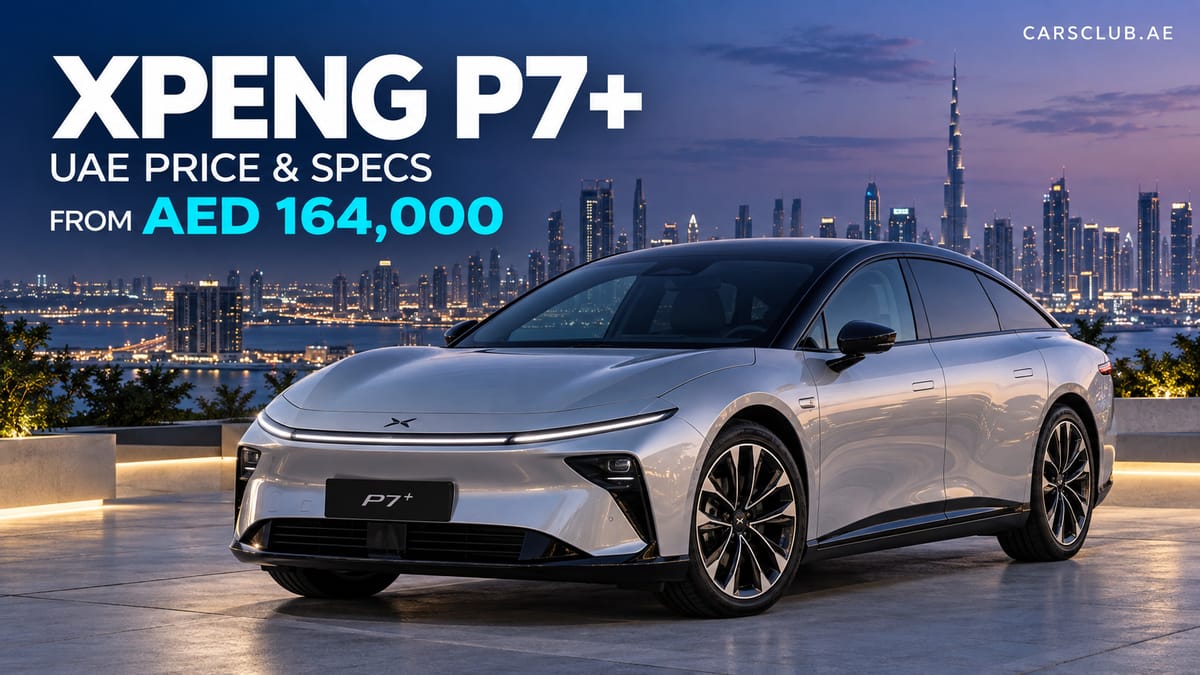
The XPENG P7+ UAE price starts at AED 164,000, and the headline number is not the price, it is twelve minutes. XPENG claims the P7+ charges from 10 to 80 percent in around 12 minutes on a compatible DC charger, courtesy of an 800-volt silicon-carbide platform with 5C charging.
That is the fastest charging claim made by any electric car sold in the UAE at this price. It went on sale on 20 August 2026 according to DriveArabia, with cars in XPENG showrooms for test drives.
What AED 164,000 buys
| Specification | XPENG P7+ |
|---|---|
| Platform | 800V silicon carbide |
| Charging | 5C; 10-80% in ~12 min on compatible DC |
| Wheelbase | 3,000 mm |
| Boot | 573 L, 1,931 L seats folded |
| Seats | Five |
| Interior | Nappa leather, microfibre suede headliner, 35 storage compartments |
| Software | Tianji XOS, XPILOT ASSIST with 14 active safety functions |
A 3,000 mm wheelbase is long, longer than most executive saloons sold here, and in a five-seat fastback that translates directly into rear legroom. Combined with 573 litres of boot space, this is a genuinely large car sold at a mid-market price. If you have been looking at the electric cars listed on CarsClub and finding that everything roomy costs north of AED 250,000, the P7+ is the first serious challenge to that.
The 12-minute claim
Read the claim carefully. It is 10 to 80 percent, in around 12 minutes, on a compatible DC charger. Every one of those qualifiers matters in the UAE.
The 10-to-80 window is the fast part of any charging curve; the last 20 percent always takes disproportionately longer, so a 12-minute figure is not a 12-minute full charge. "Compatible" means a charger capable of delivering the peak rate, and the UAE's public network is still dominated by units that cannot. Plugging an 800-volt car into a 50 kW DEWA charger gets you 50 kW, not the headline rate.
There is a second UAE-specific caveat nobody mentions at a launch: heat. Battery thermal management limits charging speed when pack temperatures climb, and a car that has just been driven hard in August will not accept peak current the way the same car does in January. Treat the 12-minute figure as a best case on a cool day with the right hardware, not as a daily expectation.
None of that makes it a bad number. An 800-volt architecture is genuinely better than a 400-volt one, and it future-proofs the car as the charging network improves. Just do not buy it expecting twelve minutes at every stop.
The practical question is whether you have somewhere to charge at home or at the office. If you do, rapid charging is a road-trip convenience rather than a daily necessity, and you will use it a handful of times a year. If you live in an apartment building with no charger and rely entirely on public infrastructure, rapid charging is your daily reality, and then the availability of chargers that can actually deliver 800-volt rates near you matters far more than the number on the brochure. Check that before you order, not after.
Space and practicality
The 1,931-litre seats-folded figure is the most useful number XPENG published. That is estate-car territory in a fastback body, and it is the reason this car makes sense for a family rather than only for a commuter.
Thirty-five storage compartments sounds like marketing until you have lived with a car that has nowhere to put a phone, a Salik-linked parking card and a pair of sunglasses. In a market where most journeys involve toll gates, valet stands and parking apps, cabin storage is a real quality-of-life feature.
Running costs are where an EV earns back its premium here. You pay no petrol, check what you would otherwise be spending at current UAE petrol prices, and you skip oil services entirely. Salik is AED 4.20 off-peak and AED 6.30 in peak windows, including the 5% VAT added on 1 June 2026; our Salik charges guide has the detail. Insurance on a new Chinese EV is the variable to check before you commit, because some UAE insurers still price unfamiliar brands conservatively.
What XPENG has not said
This is the uncomfortable part, and it matters more than any spec above.
Battery capacity, range, power output and 0-100 time were not published at the UAE launch. For an electric car, range is the single most important number a buyer needs, and it is missing. Any figure you see quoted elsewhere is either taken from a different market's specification or estimated, and a Chinese-market CLTC range figure is not comparable to what you will see on Sheikh Zayed Road in July with the air conditioning at full tilt.
Do not order this car without a written range figure from the dealer, ideally WLTP, and ask specifically what it drops to with climate control running. Also confirm the battery and drivetrain warranty terms in writing, and whether XPENG's UAE service network covers the emirate you actually live in.
How it sits against rivals
At AED 164,000 the P7+ undercuts most established electric saloons in the UAE while offering a faster charging architecture than several of them. What it does not have is a resale track record. XPENG is new here, and the used market has no data on what a three-year-old P7+ is worth.
That is a real cost, not a theoretical one. Chinese brands that arrived here five years ago now have visible residual curves, and the pattern is consistent: the first two years depreciate harder than an established badge, then the curve flattens once the brand is familiar enough that used buyers will consider it. Whoever owns the car through that first steep stretch pays for the brand's arrival. Before buying any new nameplate, run a comparable established model through CarsClub's valuation tool to see how a known quantity depreciates, then decide whether the P7+'s price advantage is bigger than the residual risk. If you plan to keep the car five years or more, it probably is. On a two-year hold, it probably is not.
Also confirm the car is a GCC-specification unit supplied through the official channel rather than a grey import, our guide to buying Chinese cars in the UAE, official versus grey import, explains why that distinction decides your warranty.
Related reading: the Farizon V7E electric van and the Soueast S08 7-seater SUV.
Frequently Asked Questions
How much is the XPENG P7+ in the UAE?
The XPENG P7+ starts at AED 164,000, announced at its UAE launch on 20 August 2026. Cars are in XPENG showrooms for test drives. Registration, insurance and any home charger installation are additional, so ask for an on-road total rather than the list price alone.
What is the range of the XPENG P7+?
XPENG did not publish a battery capacity or range figure at the UAE launch. Request a written WLTP range from the dealer before ordering, and ask what it becomes with air conditioning running. Treat any unattributed range figure you find online as unverified.
Does the XPENG P7+ really charge in 12 minutes?
XPENG claims 10 to 80 percent in around 12 minutes on a compatible DC charger using its 800V silicon-carbide platform. That requires a charger capable of the peak rate, and high battery temperatures in UAE summer conditions will reduce it. It is a best case, not a typical case.
How big is the XPENG P7+ boot?
The boot holds 573 litres with the rear seats up and 1,931 litres folded, on a 3,000 mm wheelbase. That is estate-car capacity in a five-seat fastback, and it is the strongest practical argument for the car over similarly priced electric saloons.
Is the XPENG P7+ a good buy compared with other EVs in the UAE?
On price and charging architecture, it is competitive. The open question is resale, because XPENG has no UAE used-market history yet. It suits a five-year-plus ownership plan better than a short hold where an unproven residual becomes the dominant cost.
Verdict
The XPENG P7+ is a large, fast-charging electric car at a price that undercuts the established names, and the 800-volt platform is a real technical advantage rather than a marketing one. The gap in the story is range, which XPENG has not published for this market, get it in writing before you order.
Compare it against what is listed now among electric cars on CarsClub, or browse sedans for sale in the UAE to see what AED 164,000 buys on the used market instead.