Auctions are Dubai's worst-kept car-buying secret: fleet cars, bank repossessions, government vehicles and salvage stock all cross the block every week, often hammering well below retail. But auctions are also where unprepared buyers make expensive mistakes - no test drives, as-is sales and adrenaline bidding are a costly mix. This 2026 guide explains how Dubai car auctions actually work, what they cost, and how to bid like the professionals who fill the front rows.
The types of car auctions in Dubai
- Public and fleet auctions - ex-fleet, lease-return, bank-repossessed and government vehicles, usually clean and drivable. Emirates Auction is the biggest name, running near-daily online and live events.
- Salvage and insurance auctions - accident-damaged and written-off vehicles sold for repair, parts or export. The cheapest metal in the market, and the highest risk.
- Classic and special-interest sales - occasional auctions for collectibles and modern classics, where documented history drives the price.
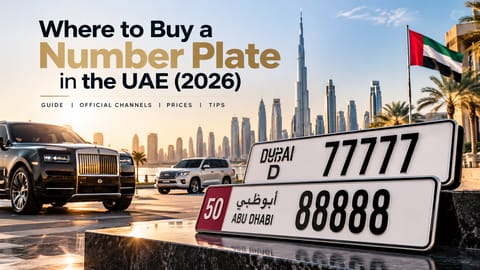
- Number plate auctions - the RTA regularly auctions distinctive Dubai plates, online and in headline live events. That is its own world; see our Dubai number plates guide and browse plates for sale.
How to register and bid
Registration is straightforward: sign up with the auction house using your Emirates ID (or passport for visitors, trade licence for companies) and place a refundable security deposit - typically AED 1,000-5,000, more for premium sales. That deposit sets your bidding limit at many houses. You can then bid three ways: in person at the live auction, online in real time through the auction platform or app, or by leaving a maximum proxy bid in advance. Set your ceiling before the sale starts - the entire format is engineered to push you past it.
Inspect before you bid - always
Auction cars are sold as-is, where-is, with no warranty and no returns. Everything therefore hangs on the pre-sale inspection:
- Attend the viewing days. Most houses open the yard for one to three days before the sale. Bring a mechanic if you can; check panels, paint depth, tyres, fluids and the engine bay. You can usually start the engine, but not drive.
- Run the VIN. A free VIN check reveals accident history, and for imports, US salvage records - many auction lots are re-imported American cars, so read our GCC vs American specs guide before bidding on one.
- Read the lot listing. Auction houses grade condition and disclose known faults, mileage discrepancies and title status. "Salvage" or "non-runner" flags change the maths completely.
- Price the exit first. Check what the same model sells for retail on our used cars pages - auction favourites like the Toyota Hilux, Land Cruiser and Corolla, and Nissan Patrol and Sunny, have deep, liquid markets that make resale values easy to verify.
Fees, payment and paperwork
Budget beyond the hammer price. Typical costs: a buyer's commission of around 5%, a fixed admin/processing fee, and VAT on those fees. Payment is usually due within 24-72 hours, and storage charges start if you are slow to collect. Then come the normal ownership steps - RTA technical inspection where required, insurance in your name, and the RTA ownership transfer. Financing an auction car is harder than a dealer purchase since banks want the car first; most auction buyers pay cash, so work out your true budget with the car loan calculator before the sale, not after. For a sense of what solid retail cars cost instead, browse used cars under AED 50,000.
Auction cars for export
A huge share of Dubai auction stock never gets re-registered locally - it ships out. Exporters buy fleet Hiluxes, Land Cruisers and pickups for Africa, and sedans and SUVs for the CIS, then take an export certificate and export plates from the RTA instead of local registration and ship from Jebel Ali. If that is your plan, our step-by-step car export guide covers the certificate, customs documents and shipping options, and you can browse ready cars for export from Dubai on CarsClub.
Five mistakes that cost first-time bidders
- Bidding without viewing - photos hide sandstorm pitting, flood damage and paintwork.
- Ignoring title status - a salvage title means repair costs, re-testing and a permanent resale discount.
- Forgetting the fees - 5% commission plus charges can erase a "bargain" margin.
- Auction fever - decide your maximum from retail comparisons and stop there. A free car valuation on the same model gives you that ceiling before the bidding starts.
- No plan for the car - transport, insurance and transfer deadlines start the moment the hammer falls.
Frequently asked questions
Can anyone buy a car at auction in Dubai?
Yes. Public car auctions in Dubai are open to residents and visitors alike - you register with your Emirates ID or passport, place a refundable security deposit (typically AED 1,000-5,000 depending on the auction house), and you can bid in person or online. Companies can register with a trade licence, which is common for exporters buying in volume.
Are auction cars cheaper than buying from a dealer in Dubai?
Usually yes - fleet, bank-repossessed and government vehicles often hammer for 10-30% below retail because they are sold as-is with no warranty. The saving is real but so is the risk: you cannot test drive, returns are not possible, and buyer fees of around 5% plus admin charges narrow the gap. Salvage cars go far cheaper still, but need repair budgets and re-testing before registration.
What fees do I pay at a Dubai car auction?
On top of the hammer price, expect a buyer's commission (commonly around 5%), a fixed admin fee, and VAT on the fees. You will also pay the normal RTA ownership-transfer and registration charges, and for salvage vehicles, the cost of repairs plus a technical inspection before the car can be registered.
Can I export a car I bought at auction in Dubai?
Yes - auctions are one of the main sources for the UAE's car export trade. After winning, you obtain an export certificate and export plates from the RTA instead of registering the car locally, then arrange shipping from Jebel Ali. Buyers across Africa and the CIS source Toyota Hilux, Land Cruiser and similar models from Dubai auctions every week.
Auctions reward preparation: inspect on viewing day, verify with a VIN check, price the retail exit on used cars, and bid with a hard ceiling. Prefer a car you can test drive with recourse if something is wrong? Start with verified listings on our car search, read the used-car buying guide, and make sure your insurance is arranged before the RTA transfer.